Commercial Banks’ Assets

Post originally written by @AndyKhalil1 on twitter

Below are banks’ assets expressed as a share in total assets. Note the acceleration in the share of deposits at BDL &the reduction in that of all other variables, especially post 2016 when FE (Financial Engineering) commenced. Where is the efficient financial intermediation & allocation of capital?
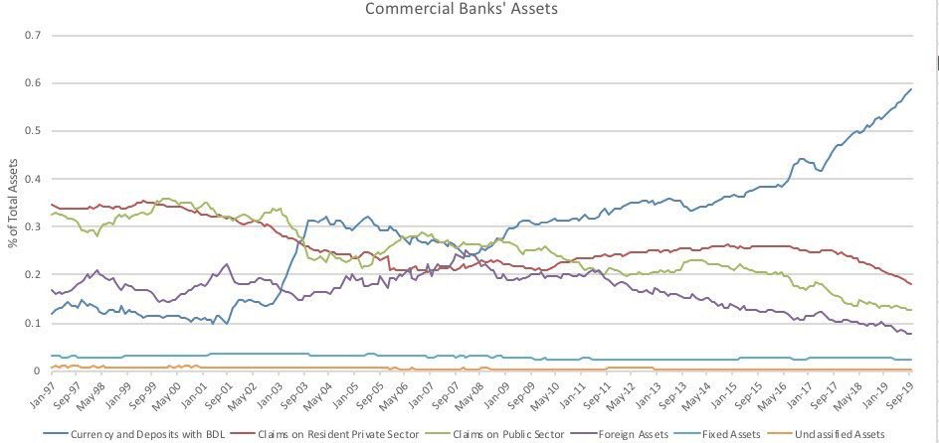
Source: BDL

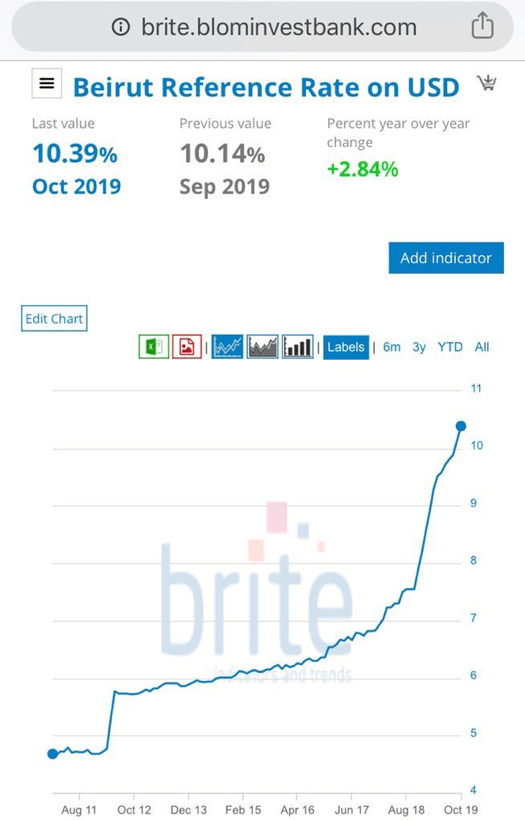
Notice how the $ BRR (Beirut Reference Rate), the benchmark banks use to determine the interest rate they charge on $ loans, accelerated throughout the same period. This greatly impedes the private sector’s ability to invest in the economy and tremendously inflates the cost of its existing debt.
Image

“Currency and deposits with BDL tell the story”  – @HuseinNourdin

In monetary economics when these expand at this rate and to this level. It is quantitative evidence of a Ponzi scheme on reserves, which is equivalent to the insolvency of the central bank. Fiscal support would hinder this but our government is also running a huge deficit. – Andy

“an increased fiscal deficit can be tolerated had it not been for the foreign debt in Eurobonds where they need to come up with real dollars to meet maturities of foreign held paper” – @NabilKurd

Tolerated yes but it also impedes the government’s ability to subsidize the central bank when it suffers from negative net income and net worth. – Andy

“No subsidies to the CB. In fact the CB will keep on printing to bail out the government for next month’s state salaries & exp and for the foreseeable future” – @NabilKurd

Hence the inevitable insolvency of both – Andy

Has BDL not recorded costs?

Post originally written by @EHSANI22 on twitter.

How does an entity pay excessive rates on astronomical sums of money (nearly $ 150 billion) and yet not record costs of such an operation anywhere in the system?  Based on countless hours of research, set below is a possible explanation. Remember Banque du Liban publishes a balance sheet (well sort of) but is yet to put out an income statement for over 15y. It is stunning that country’s politicians have demanded no such statement from a man who has been at the job since Aug 93 & who now mangers $142 billion in liabilities.

Image of the building of Banque du Liban

When crisis unfolded, many analysts and observers pointed out the difference between gross & net reserves. In effect, while BDL pointed to its assets (reserves), it wanted you to ignore its much larger liabilities (loans from banks). This issue has already been covered.

But now our curiosity was raised when we noticed an item on BDL balance sheet (BS) that was experiencing a rather dramatic rise of late & as the crisis deepened “Other Assets” now accounts for $26.5 billion & is up 100% in a single year. Just this month alone it jumped $3.3 billion. The fact that a line item now accounting for 19% of BDL’s total assets has doubled in size as the crisis deepens ought to raise a flag Indeed, at December’s pace “Other Assets” are likely to pass the much talked about Gross Reserves number by February. What is going on here?

First hint came by observing how doubling of “Other Assets” came while bank deposit rates rose substantially over same period. When one considers that bank lending to BDL is $151 billion, such explosive jump in rates start to add up to a very large interest expense

BDL does offer a footnote on its balance sheet that states Other Assets “includes open market operations & seigniorage” If Other assets are increasing due to seigniorage, then BDL is creating new liras to cover the interest it owes to banks Ps google seigniorage definition

Another possible explanation for the increase in “Other Assets” is that BDL is covering some of the Govt’s expenses. But, BDL could have increased its “loans to public sector” as by law it must cover Govt deficits. But doing above will show much larger effective Govt liability

Other Assets may also include part of the Govt’s dollar deficit which it can’t fully pay using Eurobond proceeds. Rather than allowing Dollar demand to finance imports deplete its reserves, BDL increases “other assets” by the same amount

Back to interest expenses on the massive borrowing from banks. Remember BDL earns way less from its assets than what it pays the banks on the loans. To fund this negative carry, BDL needs to suck more & more of these loans from banks Here is what happens on the process

Suppose that net cost of borrowing from banks is $100. BDL must draw down on its gross reserves to make this $ expense payment. But as reserve assets are drawn down by $100, it must draw down its equity capital by same amount BUT & Stunningly, BDL capital hardly ever changes.

Design a site like this with WordPress.com
Get started